Why standardize playback racks?
Designing our own playback racks first allowed us to save a lot of time during the prep phase. Previously, every departure required handling and reconfiguring part of the gear, along with the risks of damage and mispatching that came with it. With standardized, pre-configured racks, we have a common foundation across all our setups. It also streamlines troubleshooting and allows us to replace or send out an identical rack without rebuilding the configuration from scratch every time. Beyond saving time, this standardization primarily brings us reliability and consistency across operations.
 What factors led to adopting the LIOBOX2?
There was definitely demand from the field—starting with MMBS early on—but we also quickly recognized the value of the solution offered, first by the LIOBOX and then by the LIOBOX2. The ability to control the system remotely was a major plus for our touring workflows. It directly addressed specific constraints faced by operators. The fact that it is a French-made product also weighed into our decision. We wanted to support its development and work with a manufacturer we could talk to directly regarding real-world field needs.

Why choose a 19U rack format with lid-integrated screens?
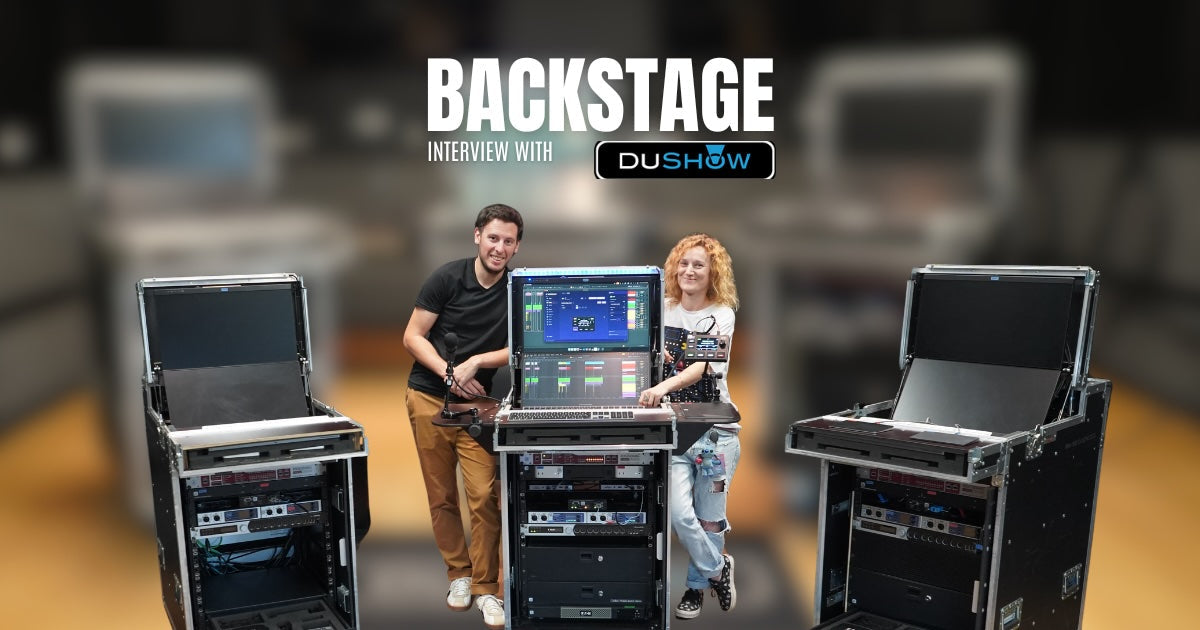
Integrating the screens into the rack cover costs us 5U of usable space, but with a standard 19U rack, we still have 14U left for the setup. We found this to be a worthwhile trade-off considering the benefits. Built-in screens eliminate a whole series of repetitive setups. You no longer have to hunt down monitor stands or loose cables in a fly case at load-in, there's no need to handle separate screens daily—which reduces the risk of damage—and above all, it drastically reduces on-site wiring. It saves operators time during both setup and tear-down, while minimizing damage risks and simplifying inventory management. Right from the design phase, we set a key constraint: maintain a maximum height of around 1.50 m (approx. 5 ft) so the rack doesn't block the operator's line of sight. The goal was to strike the best balance between integration, ergonomics, and footprint.

How do you ensure rack compatibility with different audio console formats?
We chose MADI as our protocol because it best met the constraints of this type of system. It is straightforward to implement, highly efficient, and offers latency-free transmission. It is also widely used enough that a broad selection of conversion options is available today. Once the signal exits the rack in MADI, it can be converted to Dante, analog, AVB, or other protocols used in pro audio. This allows us to keep a common rack architecture while remaining flexible enough for whatever FOH/monitor setup we encounter.

What technical and ergonomic advantages motivated integrating the LIOBOX2 into Dushow playback racks?
From a technical standpoint, a main benefit of the LIOBOX was having control both at the playback rack backstage and directly on stage. With the LIOBOX2, we can control both computers in the rig without setting up extra protocols like RTP or MIDI. For us, that is a real advantage: the fewer configuration layers you add to a mission-critical system, the easier it is to set up and operate. Ergonomics played a big role too. The unit is compact enough to integrate easily into a musician's stage setup or fit right into rack drawers for transport. That compact form factor doesn't sacrifice functionality, making it exceptionally well suited to our workflow.
How are audio sync and automatic failover between Main and Spare handled?
Each rig features an external word clock. It can either generate the reference clock for the entire audio setup or distribute an incoming word clock from the console to feed both MADIface XT units. For automatic Main/Spare failover, we selected an EXBOX BLDS. It is simple to operate and gives us a GPI remote manual trigger alongside a GPO status output. We use that GPO output to drive internal rack lighting, giving a clear visual indicator of system status. The operator can instantly see which machine is active, adding a simple yet essential layer of operational feedback.
How much time and efficiency do standardized rigs save at the shop?
To give a sense of scale, a full rig built from scratch previously took half a day of racking plus another half day of setup and testing. With pre-built, standardized rigs, we can pull a unit from stock, check it, and test it in about an hour. The time savings are substantial, but that's not the only benefit. Rack build quality and cleanliness are now completely consistent. Every rig is built to the exact same standard, making us faster and far more thorough. Post-tour check-in is also much easier. We incorporated custom foam-lined drawers to store the LIOBOX2 and all its accessories—like mounting bases and mini friction arms—making it easy to audit gear down to the smallest items that usually get lost.

How does standardization enable fast rack swaps during a failure?
Gear reliability and quick emergency response are paramount for all our operations. Standardization provides identical setups so we can swap units out extremely fast. A replacement rack can be prepped and dispatched without rebuilding a specific configuration or relearning its layout. In a touring environment where time is severely limited, this repeatability is a massive asset.
How does Dushow manage software licenses in playback racks?
UAD processing is among the options we integrate into our racks, so license management is something we must account for—though it extends beyond UAD. Because every developer uses its own licensing system—some far less refined than others—we sometimes have to handle these on a case-by-case basis. At our operational scale, we try to favor systems offering professional license management with dedicated interfaces and, where possible, remote management. For a fleet of equipment deployed constantly across different productions, this aspect quickly becomes as critical as hardware specs.
How have operators, crew, productions, and artists responded to playback rack standardization?
We built these racks around real feedback and field requirements. We took the time to co-develop them with operators so that ergonomic and architectural decisions directly addressed their daily constraints. As a result, standardization was very well received. It met genuine field demand by offering operators a familiar layout and workflow from one tour to the next. The goal was never standardization for its own sake, but rather building a shared tool that genuinely makes their job easier. Feedback has been overwhelmingly positive. The format has become standard on our tours, and all parties have embraced this workflow. For technical crews, the main win is simplicity: the rack is identified, organized, and functions the exact same way every time. This reduces setup time and allows crews to focus on show execution. For productions and artists, standardization delivers peace of mind. Playback is a vital show element; knowing you have a reliable, proven solution secures the entire performance chain.
How did rack standardization handle a real-world emergency?
We recently had a textbook example: a rack fell out of the truck during load-out. In that scenario, things can turn critical quickly if you are dealing with a custom rig that has to be rebuilt from scratch under time pressure. In our case, standardized racks enabled us to ship an identical replacement immediately. It's a clear example of why we made these design choices: you don't just optimize for smooth days, but to react swiftly when unexpected issues happen.

What is playback's role in live production today, and how does standardization evolve the operator's role?
Playback systems have become central to show design. System reliability and operator proficiency are now core components of a successful performance. Today, playback operator is universally recognized as a dedicated position within a production. That wasn't necessarily true years ago, when those tasks were split across departments or added to another crew member's duties. System standardization reinforces this shift: it allows operators to focus on running the show and ensuring system stability rather than spending time troubleshooting gear integration or configuration issues.
How is the LIOBOX used on tour, at the playback rack vs. on stage?
We always put at least one LIOBOX at the main playback rack for the operator. Depending on show requirements, it's also common to deploy one or two additional units directly on stage for musicians or the DJ. This gives performers direct control access without multiplying control systems or overcomplicating playback architecture. We rarely see setups where the LIOBOX is assigned to specialized control tasks like Auto-Tune parameter changes or live looping; the vast majority of deployments use it for core playback control—either at the rack or on stage for artists.

What advice would you give to secure tour playback systems?
We always advise finding a balance between team workflow preferences and the rock-solid reliability of the technical solution. Operator habits matter, but they must fit within a coherent, secure framework built for the tour. That is our primary responsibility as an audio provider: to take those preferences into account and deliver a reliable, repeatable technical solution tailored to tour realities. The goal isn't to force change, but to integrate those workflows into a robust framework so technology seamlessly serves the show.
How does Gooroo Link impact rack and configuration management on tour?
Gooroo Link has streamlined our hardware management and firmware update processes. It provides far greater flexibility in configuration management, especially when prepping or re-prepping racks between tour legs. Operators can easily back up and export custom configurations before maintenance, then re-import them once the rack is cleared for use. Compared to Gooroo Configurator, Gooroo Link simplifies these tasks and keeps tech teams autonomous. For us, managing a fleet of racks coming in and out of the shop between productions makes that functionality invaluable.
How do Dushow racks adapt to different playback DAWs used on tour?
Ableton Live accounts for the vast majority of workflows we encounter—roughly 80% of our playback rigs run Ableton today. The remaining 20% is primarily QLab, followed by Pro Tools on occasion. Pro Tools usually comes up when a show was built or edited in pre-production in that DAW and the team wants to preserve their native workflow on the road. The strength of our rack architecture is that it remains largely DAW-agnostic. Adapting a rack to a different DAW simply requires installing the requested software and setting up the appropriate licenses—the underlying hardware architecture remains identical. That is another major strength of rack standardization: we maintain a unified hardware footprint while remaining completely adaptable to each production's software requirements.